Dr. Jyotii A Agarkar — clinician-guided weight management at SlimMD
MBBS · MD · DDV. 20 years in the wellness and cosmetic-care industry, brought to a doctor-guided weight-management program built on assessment first, individualized decisions and clear communication.
Ten chaptersAbout 56 minutesReviewed 4 September 2026No unverified claim
Plate I
01
MBBS · MD · DDVMedical qualifications and a professional credential, as supplied for the SlimMD program page.
02
20 years of practiceTwo decades in the wellness and cosmetic industry, brought to medical weight management.
03
Assessment before treatmentEvery SlimMD journey opens with a structured medical assessment, not a prescription.
04
Safety before hypePrescription choices, monitoring and changes stay individualized and clinician-led.
Quick answer
Who is Dr. Jyotii A Agarkar at SlimMD?
Dr. Jyotii A Agarkar (MBBS, MD, DDV) is the doctor profiled for SlimMD’s clinician-guided weight-management program on this page. Her approach starts with assessment, medical context and medication review before any prescription decision, and combines nutrition, movement, sleep, behaviour, follow-up and safety monitoring.
This profile is educational and does not replace an individual consultation. Prescription suitability, medicine selection, dosing and changes are decided by the treating clinician after assessment.
01
Doctor spotlight · Wellness & cosmetic care
Dr. Jyotii A Agarkar, the clinician behind SlimMD
MBBS · MD · DDV. 20 years in the wellness and cosmetic-care industry, brought to a doctor-guided weight-management program built on assessment first, individualized decisions and clear communication.
A clinician with a wellness and cosmetic-care background
Two decades of patient-facing work in wellness and cosmetic care shape how Dr. Jyotii A Agarkar approaches weight.
Dr. Jyotii A Agarkar holds an MBBS and an MD, together with the DDV professional credential. Her twenty years of experience were built in the wellness and cosmetic industry — a field in which patients arrive with a goal that is personal, visible and often emotionally loaded, and in which the clinician’s first job is to understand what the person actually wants before proposing what medicine can do.
That history matters for weight management more than it might first appear. Weight is rarely a purely metabolic question for the person raising it. It sits alongside how they feel in their clothes, their energy through a working day, their confidence at a family event and their worry about a health marker a doctor once mentioned. A clinician trained to listen for all of that, and to translate it into a plan the patient can follow, is the perspective SlimMD is built around.
The clinician-guided perspective behind the program
SlimMD is a program, not a medicine; Dr. Jyotii A Agarkar represents the judgement that decides what belongs in it.
SlimMD describes itself as a medical weight-intelligence program: assessment, medical context, nutrition, movement, sleep, behaviour, progress review and long-term maintenance, with prescription treatment as one optional component when a clinician judges it appropriate. Dr. Jyotii A Agarkar’s presence on the program page reinforces the sequence the whole program follows — understand the person, review the relevant health information, decide what is appropriate, then monitor and adapt.
In practice that means the questions a patient brings — which pathway, which medicine, how fast, what to eat — are answered inside a consultation rather than by a web page. The chapters below describe how she approaches each of those questions; they do not replace the appointment in which the answer is given for you.
A profile that publishes only what has been verified is the first evidence of the standard it describes.Chapter 01
Plate II
The four principles she works by
Individualized context, a wellness perspective, clear communication and safety before hype.
The SlimMD program page lists four principles under Dr. Jyotii A Agarkar’s name. Each has a chapter of its own below, but the shape is simple. Individualized context: care discussions reflect the person, their health context and the goals being considered. Wellness perspective: medical weight management works best when clinical decisions are coordinated with nutrition, lifestyle and sustainable routines. Clear communication: questions, expectations and next steps are explained in language patients can understand. Safety before hype: prescription choices, monitoring and changes remain individualized and clinician-led where medically appropriate.
Read together they describe a clinician who treats a GLP-1 prescription as one tool among several, who expects a plan to survive a wedding, a work trip and a bad week, and who would rather explain a decision than issue one.
“A premium care experience begins with listening carefully, understanding the individual and making the next step clearer.”Dr. Jyotii A Agarkar, as published on SlimMD
What a consultation with her covers
Seven domains are reviewed before any plan is written.
A first SlimMD consultation moves through seven domains: body (weight history, BMI, waist), health (conditions and clinician-directed investigations), medication (every current prescription, supplement and non-prescription product), nutrition (eating pattern and previous attempts), movement (daily activity and training), sleep (rest and recovery) and goals (lifestyle and what actually matters to the person). The order is deliberate: medication and health context are reviewed before any treatment is considered, because they can change what is appropriate.
What follows the assessment is a decision, not a package. It may be a lifestyle-first plan without medication, a prescription pathway surrounded by nutrition and follow-up, or a request for further investigation before either is chosen.
Weight history, BMI and waist, recorded rather than estimated
Existing conditions and whether investigations are indicated
A full medication and supplement reconciliation
How you eat now, and what you have already tried
Daily movement, training history and physical limits
Sleep duration, timing and symptoms worth investigating
The goals you name, in your own words
What this profile deliberately does not claim
A doctor page that publishes only what has been verified is the first evidence of the standard it describes.
This page does not publish a registration number, an institutional affiliation, a patient count, an outcome statistic or a photograph of Dr. Jyotii A Agarkar. The SlimMD site marks each of those as pending verification, and until they are verified the honest page is the one that says so. A monogram stands in for the portrait; the verification register at the foot of this page lists exactly which fields the operating clinic completes before publication.
The same discipline applies to the content. Where a page describes how Dr. Jyotii A Agarkar approaches a decision, it draws on the principles and program structure published on SlimMD. Where it explains general medicine — why protein matters when intake falls, what a plateau usually means — it is patient education, not a promise about your case.
The credential ledger
Every fact on this page, and where it comes from
A doctor profile is only as trustworthy as its sourcing. This is the sourcing.
Statement
Source
Status
Name: Dr. Jyotii A Agarkar
SlimMD program page, doctor spotlight
Published
Qualifications: MBBS · MD · DDV
SlimMD program page
Published as supplied; expansions to be confirmed
20 years in the wellness and cosmetic-care industry
Anything not in this ledger is not asserted about Dr. Jyotii A Agarkar anywhere on this page.
Take into the consultation
Ask which of the three outcomes — lifestyle-first, a prescription pathway, or further evaluation — the assessment points to, and why.
Ask what will be reviewed at the first follow-up, and when it falls.
Bring the goal in your own words; it is recorded as you say it.
The standard in this chapter
Nothing is asserted about the doctor that has not been verified; nothing is decided about the patient before they have been understood.Chapter 01 · Profile
Individualized context, a wellness perspective, clear communication and safety before hype — the four commitments listed under Dr. Jyotii A Agarkar’s name, and what each one changes in a weight-management consultation.
Individualized context
Two people with the same weight can need entirely different conversations.
The SlimMD program page makes the point with a comparison: one person may have normal metabolic markers and no major symptoms; another the same weight may have diabetes, PCOS, high blood pressure, suspected sleep apnoea or a complicated medication history. Treating them identically because the scale agrees would miss the person behind the measurement. Individualized context is the principle that refuses that shortcut.
In a consultation it shows up as time spent on history before any plan is discussed — previous weight changes, family history, symptoms, treatments already tried, and the goals the patient names rather than the ones a program assumes. It also shows up in what is not said: no pathway is recommended until the context that would make it inappropriate has been looked for.
Wellness perspective
Medical weight management works best when clinical decisions are coordinated with nutrition, lifestyle and sustainable routines.
A wellness perspective is not a softer alternative to medicine; it is the recognition that a prescription written without the routine around it tends to produce a temporary result. SlimMD’s program structure reflects this with what it calls the complete equation — prescription when appropriate, nutrition at every plate, protein to preserve muscle, movement that is daily and deliberate, sleep built in, behaviour rehearsed — and states plainly that the treatment journey is designed not to depend on medication alone.
Twenty years in wellness and cosmetic care is where this perspective was formed. Patients in that field are rarely satisfied by a number; they want to feel, function and present differently, and they keep only the changes that fit their lives. Dr. Jyotii A Agarkar brings that expectation to weight management: the plan has to work at the family dinner and on the busiest working day, or it will not last.
Clear communication
Questions, expectations and next steps should be explained in language patients can understand.
Clear communication is the principle most easily promised and least often delivered. SlimMD operationalizes it in small structural choices: a fast-answer panel before the deep dive, a plain-words explanation for every clinical term, expectation-setting before any prescription, and a stated refusal to publish figures, prices or response times that have not been verified. The intent is that a patient leaves each conversation able to say what was decided, why, and what happens next.
It also governs how uncertainty is handled. Where a decision depends on an investigation not yet done, or on how a first month of treatment is tolerated, the honest answer is a plan with a review date rather than a confident prediction. Patients are told which questions can be answered now and which belong to a later appointment.
Safety before hype
Prescription choices, monitoring and changes remain individualized and clinician-led where medically appropriate.
The fourth principle is the one that most distinguishes a medical program from a marketing funnel. GLP-1 medicines are effective and widely discussed, which is exactly why a program has to be disciplined about who starts them, how they are monitored and when they are stopped. SlimMD’s medical governance list — assessment before prescribing, medication reconciliation, contraindication and safety review, individualized decisions, nutrition and symptom support, follow-up and escalation — is the practical form of this principle.
It is also why some of the program’s clearest statements are refusals: no dose, schedule or product-specific instruction is published on the website; no automatic dose escalation in response to a plateau; no prescription started because a patient arrived asking for one by brand name.
Plate III
How the four principles combine in one appointment
The principles are not a checklist; they are the sequence of a consultation.
Individualized context opens the appointment: history, medication, goals. The wellness perspective shapes what is proposed: a routine first, a prescription only as one part of it. Clear communication governs how it is proposed: plainly, with expectations and a review date. Safety before hype decides what is withheld: anything that would be a promise rather than a plan.
The result is a consultation that can end in three different ways — a lifestyle-first plan, a prescription pathway, or a request for further evaluation — and a patient who understands which of the three they received and why.
“A premium care experience begins with listening carefully, understanding the individual and making the next step clearer.”Dr. Jyotii A Agarkar, as published on SlimMD
The philosophy plate
What the principles ask of the clinician, and what they promise the patient
Principles are only real when they cost something. These are the costs and the returns.
What Dr. Jyotii A Agarkar’s principles require
Of the clinician
Full history and medication reconciliation before any recommendation.
A plan that names routine, nutrition and follow-up, not only a medicine.
Explanations in plain language, with expectations set before treatment.
Willingness to decline a prescription the patient came asking for.
A scheduled review rather than a confident prediction.
What the patient can expect in return
Of the program
No pathway recommended before your context has been understood.
No result promised in kilograms, percentages or weeks.
No dose, schedule or product instruction taken from a web page.
No dose escalated automatically because the scale slowed.
No fact published about the doctor that has not been verified.
The second panel is the first panel seen from the other chair.
Take into the consultation
Ask how your health context changes what would otherwise be recommended.
Ask what the plan looks like on a day the medicine is not part of it.
Ask what would make the clinician decline a prescription you came for.
The standard in this chapter
A consultation that can end three different ways, with the patient knowing which one they received and why.Chapter 02 · Philosophy
What happens in a first consultation with Dr. Jyotii A Agarkar
The structured medical assessment that opens every SlimMD journey — seven domains, one sequence, and a decision at the end that may or may not involve a prescription.
What the online assessment does, and does not do
The form prepares the clinical conversation; it does not make a clinical decision.
SlimMD’s online assessment asks for name, age, height, weight, health conditions, current medicines and a preferred next step, and shows a screening BMI. The site is explicit that this does not diagnose, determine prescription eligibility or replace a consultation. Its purpose is to organize information so that the appointment can start with substance rather than paperwork.
Useful preparation is modest: a list of every medicine and supplement you take, including doses; any recent laboratory reports; a rough weight history over the past five to ten years; and an honest account of what you have tried before and why it stopped. None of this is required to book — but all of it shortens the path to a decision.
SlimMD’s assessment hall lists seven domains. Body covers weight history, BMI and waist. Health covers existing conditions and clinician-directed investigations. Medication covers every current prescription. Nutrition covers eating pattern and previous attempts. Movement covers daily activity and training. Sleep covers rest and recovery. Goals covers lifestyle and what matters to you.
The sequence is not arbitrary. Health and medication come before nutrition and movement because a thyroid disorder, a diabetes medicine or a psychiatric prescription can change what is appropriate to recommend in the later domains. Goals come last so that they are heard in the light of everything before them — and so that a goal which the clinical picture makes unrealistic can be discussed rather than silently accepted.
Domain
What is asked
Why it comes at this point
Body
Weight history, BMI, waist
Establishes the baseline every later decision is measured against
Health
Conditions, symptoms, investigations
Identifies contraindications and what needs evaluating first
Medication
Every prescription, supplement, OTC product
Interactions and overlapping therapy must be known before any pathway
Nutrition
Eating pattern, previous attempts
Shows what has failed before and what the plan must survive
Movement
Daily activity, training, limits
Sets a realistic starting point rather than an ideal
Sleep
Duration, timing, symptoms
Appetite and adherence depend on it; some symptoms need referral
Goals
What matters to you
Heard last, so it is heard in full context
Plate IV
Why the medication list gets so much attention
Some medicines influence weight, appetite or how a plan should be built; they are context, never an afterthought.
A person may arrive wanting to discuss a weight-loss injection while already taking medicines for diabetes, blood pressure, mood or thyroid disease, plus vitamins or supplements bought independently. SlimMD treats those details as material: they can change what is appropriate, what needs monitoring and which symptoms deserve attention. Over-the-counter products belong on the list because natural does not mean irrelevant.
Two things follow. First, no medicine prescribed by another clinician is stopped, switched or dose-adjusted for the purpose of losing weight without that clinician’s involvement. Second, where a current medicine is suspected of affecting weight, the conversation is about coordination, not substitution — stopping it can create far greater risk than the weight concern itself.
The three ways a first consultation can end
A decision, not a package.
The first outcome is a lifestyle-first plan: nutrition, movement, sleep and behaviour support with structured follow-up and no prescription. SlimMD states that these systems stand on their own when prescription treatment is not appropriate, not desired or not needed. The second is a prescription pathway — NOVASLIM or MOUNJARO CARE within the SlimMD framework — chosen because the clinical picture supports it and surrounded by the same nutrition and follow-up. The third is a pause for further evaluation: investigations, a specialist opinion or a review of a current medicine before either of the first two is chosen.
Which outcome you receive is explained, in plain language, together with what happens next and when the first review falls. Patients who arrived expecting a particular medicine are told why a different route was chosen, if it was.
SlimMD’s twelve-week structure opens with a foundation phase in weeks zero to two. Whatever the outcome of the consultation, this phase is about the same things: understanding the plan, establishing meal structure with protein at each main meal, hydration, a sleep window and a movement baseline. If a prescription pathway was chosen, this is also when expectation-setting and product-specific education take place, from the approved information for the exact medicine prescribed rather than from the website.
The first review is scheduled at the consultation, not left to the patient to request. Early follow-up is more frequent by design; it is the point at which tolerability, adherence and any clinically relevant change are checked before momentum is expected.
The preparation plate
Bring this, leave that for the appointment
SlimMD’s own advice on what helps a first conversation, and what is better discussed in the clinical assessment itself.
Useful to have ready
Bring
Every medicine and supplement you take, with doses.
Recent laboratory reports, if any.
A rough weight history over the past several years.
What you have tried before, and why it stopped.
Your preferred contact method and availability.
The goal in your own words.
Better discussed during clinical assessment
Leave for the room
Prescription eligibility and dosing.
Contraindications and risk assessment.
Interpretation of investigations.
Treatment changes or side-effect management.
Whether a specific brand is right for you.
Detailed medical history through a general contact form.
The first list makes the appointment shorter. The second list is why the appointment exists.
Take into the consultation
Bring every medicine and supplement, with doses, on one list.
Bring a five-year weight history, however rough.
Bring what you tried before and the reason it ended.
The standard in this chapter
Medication and health context are reviewed before any pathway is proposed; goals are heard last so they are heard in full.Chapter 03 · First consultation
How Dr. Jyotii A Agarkar decides whether medication belongs in your plan
Suitability is a clinical decision. This page explains the sequence behind it — eligibility review, medication reconciliation, contraindication check, expectation-setting — and the product-specific information that stays with the prescription, never the website.
Why suitability is a clinical decision
Eligibility depends on the exact medicine, its approved indication, your history, your current medicines and the clinician’s assessment.
SlimMD states the position without hedging: prescription weight-management treatment is not automatically appropriate for every person. Some health conditions and some current medicines make it inappropriate. A program that begins with a prescription therefore begins with an assumption that has not been tested; a program that begins with an assessment is testing it.
This is also why Dr. Jyotii A Agarkar’s consultation does not open with the question the patient most often brings — which injection? — but with the question that makes that one answerable: what does the complete medical picture allow?
What the clinician reviews before any prescription
The SlimMD eligibility list, item by item.
The program page lists what a clinician may review: weight and weight history including BMI and waist where relevant; existing medical conditions and symptoms; current prescriptions, non-prescription products and supplements; allergies, previous treatment experience and tolerability; potential contraindications or interaction concerns; pregnancy or reproductive considerations where relevant; nutrition, hydration, gastrointestinal symptoms and eating pattern; and whether investigations are clinically indicated.
Each item can change the decision. A reproductive plan can rule a medicine out for now. A gastrointestinal history can change how a first month is monitored. A current medicine can require coordination with the clinician who prescribed it before anything is added.
Weight, weight history, BMI and waist
Existing conditions and symptoms
Prescriptions, non-prescription products and supplements
Allergies, previous treatment experience and tolerability
Contraindications and interaction concerns
Pregnancy or reproductive considerations
Nutrition, hydration and gastrointestinal pattern
Whether investigations are indicated first
NOVASLIM and MOUNJARO CARE, and how the choice is made
Two medical pathways, one clinical philosophy; the medicine is chosen after the assessment, not before it.
Within SlimMD, NOVASLIM is described as a doctor-guided pathway in which a semaglutide-based treatment may be considered when clinically appropriate, and MOUNJARO CARE as a pathway built around tirzepatide when the treating clinician considers it medically appropriate. The contact page adds the caution that matters most here: the two are different molecules, and treatment selection should never be based on brand preference alone.
Patients are told they do not need to choose the medicine before the assessment. The choice between the two — or the decision to use neither — is made on the clinical picture, the approved indication, tolerability considerations and the individual’s circumstances, and it is explained rather than announced.
Dose, schedule and product instructions travel with the prescription, never with a web page.Chapter 04
Plate V
What is said before a prescription is written
Honest expectation-setting comes before the prescription, not after the first month.
SlimMD’s before-starting list places patient education and honest expectation-setting alongside history, medication and contraindication review. Concretely, that conversation covers what the medicine is intended to do and what it is not; that results vary and no figure is promised; that early gastrointestinal effects are common with this class and are managed with meal structure and hydration in the first instance; that a plateau later is normal and will be reviewed, not escalated automatically; and that nutrition, movement and sleep are not optional extras but the part of the plan that makes the result last.
The patient also hears what would prompt a call to the clinical team and what would prompt emergency care — before either is needed.
Why dose and schedule are never on the website
Medicine-specific details belong to the exact medicine prescribed and its current approved information.
SlimMD does not publish a dose, an escalation schedule, a missed-dose rule, storage instructions or a contraindication list for any medicine, and states that it does not substitute generic assumptions for product-specific instructions. Those details differ between products and between patients, and they change as approved information is updated. They are given for the exact medicine prescribed, by the treating clinician, from the current approved information — and the patient is told never to change dose, frequency or schedule without that clinician’s instruction.
This is not caution for its own sake. It is the mechanism by which a program keeps the prescription attached to the person it was written for.
Monitoring, and how a prescription can end
Treatment decisions, dose adjustment, and discontinuation follow the treating clinician throughout.
During treatment, SlimMD describes tolerability review, nutrition and hydration support and scheduled clinical follow-up as continuing throughout the journey. Reviews are more frequent early, when tolerability and adherence are being established, and settle into a steady cadence through maintenance. Dose adjustment is a review decision, never a response to a number on a scale.
A prescription can also end. It may be stopped for tolerability, for a change in the medical picture, because the goal has been reached and a maintenance plan is in place, or because the patient chooses to stop. Each is a clinician-led conversation, and the routine built around the medicine is what remains when it is withdrawn.
The decision ledger
Where each part of the prescription decision is made
Some questions are answered on the website. Most are answered in the room. This ledger says which is which.
Question
Answered by
Where
Is prescription treatment appropriate for me?
The treating clinician, after assessment
Consultation
Which pathway — NOVASLIM or MOUNJARO CARE?
The treating clinician, on the clinical picture
Consultation
What dose, and how is it escalated?
The clinician and the approved product information
Prescription
What if I miss a dose?
Product-specific rules from the clinician
Prescription
How do I store and travel with it?
Product-specific instructions
Prescription
What should I eat during treatment?
The SlimMD nutrition framework, individualized
Consultation and website
What symptoms need a call, and which need emergency care?
Set out before treatment; product warnings from the clinician
Consultation and website
How is a plateau handled?
Structured review, never automatic escalation
Follow-up
If a question in the first column has been answered for you by a web page rather than a clinician, that is the sign to ask again.
Take into the consultation
Ask what in your history would rule a medicine out, not only what would allow it.
Ask what the first month is expected to feel like, and what would prompt a call.
Ask how a prescription in this program ends, and what remains when it does.
The standard in this chapter
The prescription is one tool inside a plan, chosen after the picture is complete, and it stays attached to the person it was written for.Chapter 04 · Prescription decision
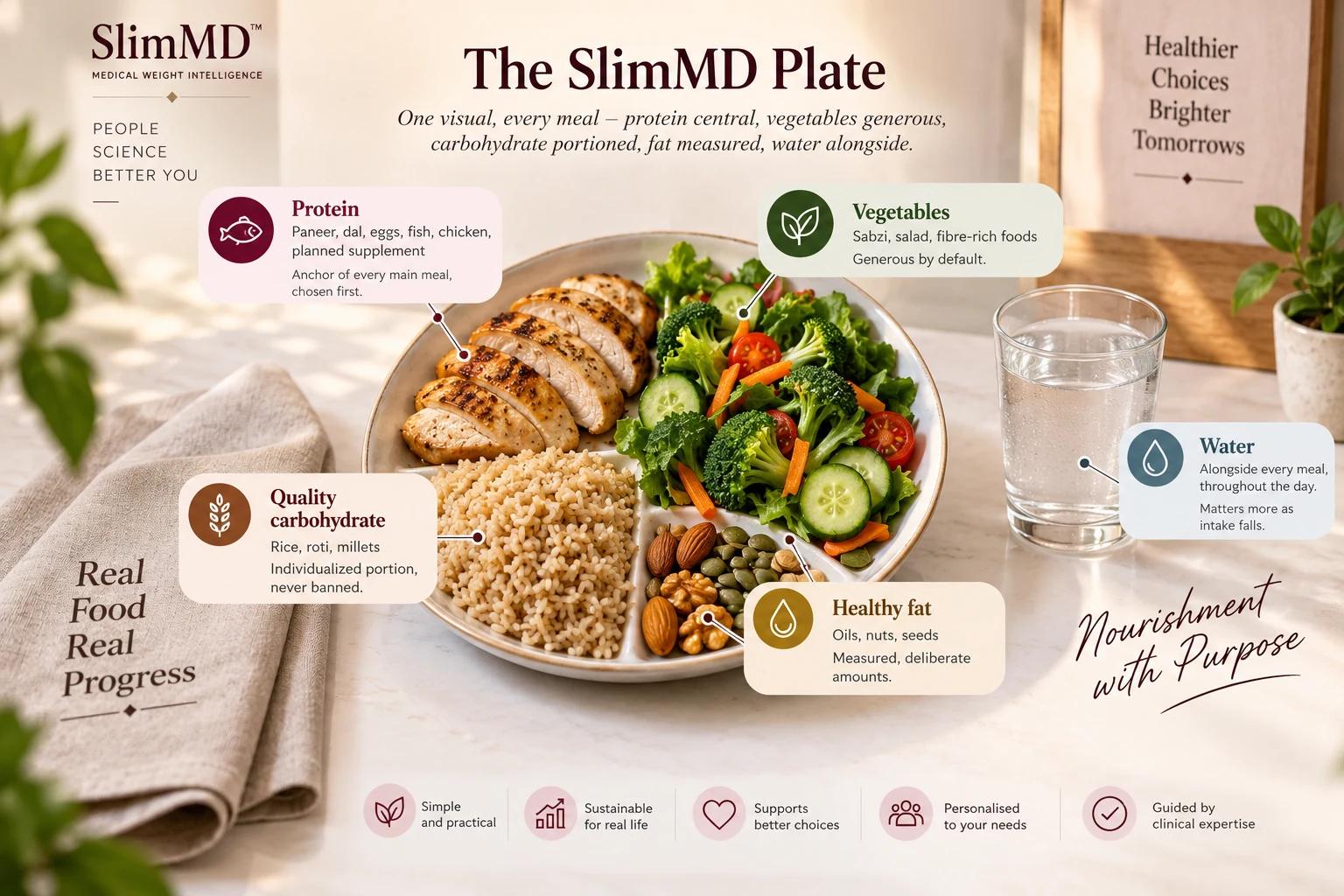
How Dr. Jyotii A Agarkar’s SlimMD plan approaches eating: the SlimMD Plate, a vegetarian and non-vegetarian protein rotation built from familiar Indian foods, micronutrient review, and the rule that a smaller plate must be a better one.
Why protein matters more as the plate shrinks
Appetite often falls faster than nutritional needs do.
SlimMD’s central nutritional observation is simple: during weight reduction, and especially on a GLP-1 medicine, appetite can fall quickly while the body’s requirement for protein, fibre, essential fats, vitamins and minerals does not fall at the same rate. A person may say they hardly ate, while most of what they ate was tea, biscuits and a small dinner with very little protein. The scale moves; the diet quietly deteriorates.
Protein contributes to normal muscle maintenance, tissue repair and satiety, and it is the nutrient most likely to be under-eaten when meals get smaller. Dr. Jyotii A Agarkar’s plan therefore treats protein as the anchor of each main meal, chosen before anything is removed. SlimMD’s own instruction is to add one protein source to the meal you already eat before subtracting anything: structure first, subtraction later.
The SlimMD Plate
One visual, every meal — protein central, vegetables generous, carbohydrate portioned, fat measured, water alongside.
The Plate is deliberately simple so that it survives without a weighing scale or a calorie app. Protein anchors it — paneer, dal, eggs, fish, chicken or a planned supplement. Vegetables bring volume, fibre and micronutrients and are generous by default. Quality carbohydrate — rice, roti, millets — is individualized in portion, never banned. Healthy fat is measured: oils, nuts and seeds in deliberate amounts. Water sits alongside every meal.
The behavioural line that accompanies it is as important as the composition: eat slowly, notice fullness, stop comfortably satisfied. On a medicine that changes hunger signals, learning to read fullness is part of the treatment.
Rice, roti and fruit are not demonized; they are planned.
SlimMD restructures the meals people already know. A vegetarian day might open with paneer or tofu bhurji, a besan chilla or a curd-based bowl; lunch is dal, sabzi, salad, paneer and curd with a controlled rice or roti portion; a snack is curd, roasted chana, planned fruit or measured nuts; dinner is protein — paneer, dal, soy — with vegetables and an individualized carbohydrate portion. The non-vegetarian pattern swaps in eggs at breakfast, chicken or fish at lunch and grilled fish or chicken at dinner.
None of this requires imported ingredients or bland restriction. The difference between the old plate and the new one is that protein arrives on purpose, vegetables arrive in volume and the carbohydrate is a portion rather than the base.
Building a vegetarian protein rotation
Paneer, tofu, curd, dals, chana, soy and beans — rotated so protein arrives with fibre and familiar flavour.
The myth that vegetarians cannot get enough protein is one SlimMD addresses directly. Paneer and tofu are versatile anchors for lunch and dinner — bhurji, tikka, grilled cubes in sabzi. Dals and legumes rotate through the week: chana, rajma, sprouts. Curd, Greek-style dahi and soy chunks lift the protein of meals that would otherwise be carbohydrate-led. Rotation is the point; the same dal every day is where plans fail.
Type, timing and quantity are individualized within the plan and reviewed with the care team, because a vegetarian rotation that works on paper still has to work at the office canteen and on a low-appetite day.
Micronutrient review, and the supplement rule
Food remains the foundation; where gaps are likely, appropriate support may be added — checked against everything you already take.
Fewer meals and smaller portions narrow the variety of vitamins and minerals food supplies. SlimMD reviews the actual diet first and, where gaps are likely, may incorporate appropriate supplementation, always checked against anything already being taken to avoid duplication and always subject to clinician review. The program names vitamin A, B-complex, vitamin C, vitamin D, iron and zinc as the nutrients most commonly considered — without publishing doses, which are individualized.
The rule these chapters return to is that a multivitamin supports a healthy diet and does not replace one. The same applies to protein supplements: a bridge for low-appetite days, travel or genuine gaps, not the foundation of the plan.
Nutrition on the days appetite is very low
Prioritize protein and fluids first when little appetite exists.
On a low-appetite day — common early on a GLP-1 medicine — SlimMD’s guidance is to prioritize protein and fluids, use smaller and more frequent meals, and simplify food. Assemble rather than cook: paneer cubes, sprouts and salad from the refrigerator become a meal faster than ordering in. For travel, roasted makhana, measured nuts and a supplement sachet keep protein possible anywhere.
Very low intake for more than a day or two is not something to endure silently. It is a reason to inform the care team, because persistent low intake can need clinical attention rather than a better snack.
The plate plate
What changes on the plate, and what stays
Patients most often fear the second list. It is the longer one.
Stays
What stays on the plate
Dal, sabzi, roti, curd, rice and fish curry.
Breakfast, lunch, a snack and dinner — four occasions, not two.
Restaurants, weddings and travel, with a playbook.
Fruit, planned rather than grazed.
Enjoyment, chosen deliberately.
Changes
What changes
Protein arrives first and on purpose at every main meal.
Vegetables arrive in volume.
Carbohydrate becomes a portion instead of the base.
Fat is measured rather than poured.
Water is scheduled, not remembered.
The plan is powerful when the healthier choice still works on your busiest day, at your favourite restaurant and at a family dinner.
Take into the consultation
Bring a typical weekday of eating, honestly, including tea and biscuits.
Name the meals you will not give up; they are structured, not removed.
Ask which protein sources fit your kitchen, your budget and your low-appetite days.
The standard in this chapter
A smaller plate must be a better one: protein first, Indian food kept, carbohydrate portioned, nothing banned.Chapter 05 · Nutrition
Five chapters describe the decision. One appointment makes it.
Everything above — the principles, the seven domains, the prescription decision, the plate — is what happens inside a first consultation with Dr. Jyotii A Agarkar. The assessment form prepares it; it does not replace it.
A structured medical assessment across seven domains
A decision explained in plain language, with a review date
Movement, sleep and stress — the routine behind the result
Dr. Jyotii A Agarkar’s wellness perspective applied to the parts of a weight-management plan that no prescription can supply: a layered movement hierarchy, sleep treated as clinical territory, and a practical answer to eating that is not hunger.
Five layers: move, strengthen, sleep, hydrate, reset
Daily steps form the base; guilt-free reset sits at the top.
SlimMD draws the routine as a pyramid. Move: daily steps and everyday activity form the base. Strengthen: resistance training supports lean tissue while weight comes down. Sleep: consistent, quality sleep supports appetite regulation and recovery. Hydrate: regular fluids matter more when appetite and intake fall. Reset: pause, review and return to routine — without guilt — after off-plan days.
The order is a statement about priority. A person who is walking daily, lifting twice a week, sleeping consistently and drinking enough has most of the routine in place before any medicine is discussed; a person doing none of these has a plan that a medicine alone will not carry.
The three rings of movement
Everyday movement builds the habit; structured activity builds stamina; resistance training gives the body a reason to keep its strength.
Movement in SlimMD is layered, not extreme. The widest ring is everyday movement — steps, stairs, chores, walking during calls — woven into the day already being lived. The second ring is structured activity: walks, cycling, swimming, for stamina and cardiovascular health. The core is resistance training, two to three sessions a week, because maintaining strength and muscle function is valuable while body weight is changing.
Dr. Jyotii A Agarkar’s starting point is the life as it is today. A person who sits for ten hours and walks two thousand steps has a different first target from someone already training four times a week. For the first, a consistent evening walk is a meaningful achievement; for the second, preserving strength deserves the attention. An unrealistic prescription produces a burst of enthusiasm followed by pain and abandonment; a baseline that progresses produces a habit.
Ring
What it is
What it builds
I — Everyday movement
Steps, stairs, chores, standing breaks
The habit
II — Structured activity
Walks, cycling, swimming
Stamina and cardiovascular health
III — Resistance training
Two to three sessions weekly
A reason for the body to hold on to strength
Weight loss should never mean ignoring muscle
Protein at every meal, resistance training two to three times a week, and adequate recovery together support lean tissue.
Rapid weight change places demands on the whole body, and not all weight lost is fat. SlimMD’s answer combines three things: deliberate protein intake, regular resistance work and proper recovery. Each supports the others — protein without training has less to build with, training without protein has less to build from, and neither works on a body that is not sleeping.
This is also why SlimMD’s progress dashboard includes strength alongside weight and waist. A week in which the scale is flat but a set of stairs is easier is a good week, and the dashboard is designed to notice it.
Plate VII
Sleep as part of the program
Short, irregular sleep makes hunger harder to read and routines harder to keep.
SlimMD asks about bedtime, wake time, sleep duration, night waking, late-night eating, screen habits and how rested the day feels. Practical changes include a more consistent sleep window, a deliberate wind-down routine, reviewing late caffeine or heavy meals and separating bedtime from habitual snacking. The site sketches an example evening — begin winding down, lower stimulation and dim screens, a consistent routine in a cool dark room, light and movement in the morning — and is explicit that the times are examples and the routine is individualized.
Sleep is also where a weight consultation can find something that needs a different clinician. Significant snoring, witnessed breathing pauses or marked daytime sleepiness are reviewed with the clinician because they may indicate sleep apnoea, which deserves evaluation rather than a bedtime tip.
Sometimes it isn’t hunger
Physical hunger builds gradually and accepts many foods; craving arrives suddenly and wants one.
SlimMD sets the two side by side. Physical hunger builds gradually, is felt in the body, is open to many foods, is satisfied by a normal meal and is comfortable to wait fifteen minutes. Craving or emotional eating arrives suddenly, is tied to a mood, a screen or a habit loop, wants one specific food, often continues past fullness and rarely satisfies the feeling underneath. Recognizing which one is present changes the outcome.
The tool is the 5-minute pause. Before eating outside the plan: am I physically hungry? What am I feeling? What do I need? Is food the only answer? What is one helpful action right now? Five minutes is often enough to turn a reaction into a decision. The program is careful to add that these tools do not trivialize significant distress — where symptoms suggest anxiety, depression, binge eating or another mental-health concern, appropriate professional assessment is important.
Habits, and the rooms you live in
Willpower is easier to use when you do not need to use it fifty times a day.
Most eating happens on autopilot — the same time, place and portion — and habits outlast motivation in both directions. SlimMD’s approach is to change a few high-impact patterns rather than issue twenty rules on day one: improve dinner and change what sits near the television to address evening snacking; put shoes at the door and walk ten minutes on arriving home to address after-work inactivity. Once one behaviour is easier, another is layered on.
Environment does the rest. A kitchen where water is visible, fruit is ready and protein is convenient asks fewer difficult questions than one where snacks sit on the counter and healthier food needs preparation. At work, carrying a planned option; at a restaurant, reading the menu beforehand; on a trip, a few anchor behaviours instead of the whole home routine. The person has not become more disciplined — the surroundings have stopped demanding discipline.
The hunger plate
Physical hunger, or something else
SlimMD’s side-by-side, because the 5-minute pause only works if you know what you are pausing for.
Physical hunger
Answer it with a meal
Builds gradually.
Felt in the body.
Open to many foods.
Satisfied by a normal meal.
Comfortable to wait fifteen minutes.
Craving or emotional eating
Answer the feeling first
Arrives suddenly.
Tied to a mood, a screen or a habit loop.
Wants one specific food.
Often continues past fullness.
Rarely satisfies the feeling underneath.
The pause is not weakness; it is the space between the feeling and the food in which another choice becomes possible.
Take into the consultation
Bring your real step count and sleep window, not the ones you intend.
Name the evening habit you would most like to change.
Ask whether any sleep symptom you have deserves its own evaluation.
The standard in this chapter
Movement starts from today’s baseline, sleep is clinical territory, and a lapse is a reset rather than a failure.Chapter 06 · Lifestyle
How progress is reviewed when the scale is only one metric
The four phases of the first 12 weeks, the ten-measure dashboard Dr. Jyotii A Agarkar’s program reviews instead of weight alone, how common early symptoms are handled, and why a plateau is a review — never an automatic dose change.
The first 12 weeks in four phases
Nothing important is rushed and nothing sustainable is skipped.
Foundation, weeks zero to two: assessment, education, nutrition, hydration, routine. Adaptation, weeks three to six: tolerance, meal structure, movement, problem-solving. Momentum, weeks seven to twelve: progress, strength, consistency, lifestyle refinement. Consolidation, beyond week twelve: a long-term maintenance strategy, a review cadence and individualized next steps.
The phases explain why early follow-up is denser. In foundation and adaptation the questions are about tolerability, adherence and whether the meal structure is holding; in momentum they shift to strength and consistency; in consolidation to what will protect the result. A program that reviews weight every week and nothing else has no way to know which phase a patient is actually in.
A good week can show up in your waistline, your energy or your strength before it shows up on the scale.
SlimMD reviews weight trend — direction over weeks, not day-to-day noise — alongside waist, energy, hunger and appetite control, strength, activity in steps and sessions, sleep consistency, nutrition in protein and plate structure, confidence in the relationship with food, and clinical markers where relevant. No example figures are shown on the site; the dashboard is built from the patient’s own data.
The point is diagnostic as much as motivational. A flat weight with a falling waist and rising strength is a different situation from a flat weight with rising hunger and poor sleep, and the two call for different conversations. Dr. Jyotii A Agarkar’s review reads all ten lines before drawing a conclusion from one.
Weight trend
Waist
Energy
Hunger
Strength
Activity
Sleep
Nutrition
Confidence
Clinical markers
A good week can show up in your waistline, your energy or your strength before it shows up on the scale.Chapter 07
Plate VIII
Practical support for common early experiences
General lifestyle responses to common symptoms — none of which prescribe medication.
SlimMD publishes practical, non-prescribing responses to the experiences most often reported early on. Nausea: smaller, slower, simpler meals; fluids between rather than with meals. Early fullness: protein first on the plate, smaller portions more often, stop when comfortable. Constipation: fluids, fibre from vegetables and legumes, daily movement. Diarrhoea: gentle food, hydration, noting triggers for review. Reflux: smaller evening meals, not lying down soon after eating. Reduced appetite: protein and fluids first. Hydration difficulty: scheduled sips through the day rather than large volumes at once.
Each response carries the same boundary: persistent, severe or worsening symptoms require clinical review, and medication is never adjusted by the patient in response to a symptom. The symptom is brought to the review; the review decides.
The scale slowed; the journey didn’t
Still water is not stopped water.
Plateaus are common in longer-term weight management, and SlimMD treats them as a review rather than a failure. Eleven points are walked with the care team before anything changes: nutrition quality, portions, beverages, movement, strength training, sleep, stress, medication adherence, bowel habits, measurement consistency and clinical review. Very often the plateau has an explanation on that list; sometimes it is simply the body settling at a new weight for a period.
One line is repeated in bold on the program page and deserves repeating here: automatic dose escalation is never the answer — clinical review is. A plateau that ends with a higher dose and no review has skipped the eleven questions that would have told the clinician whether the dose was the problem at all.
How often progress is reviewed
More frequently early in the journey, at a steady cadence through maintenance — set with the clinician, not left to chance.
The schedule is individualized and agreed at the consultation. Early reviews check tolerability, adherence and any clinically relevant change; later reviews check that routine, strength and the food environment are holding, and whether the treatment plan should change. Reviews are also where the dashboard is read in full and where the plan is adapted as health information, tolerability and progress evolve.
Between reviews, the patient is not on their own: SlimMD’s contact pathways route existing-client questions to clinical review, nutrition and lifestyle support or administration — with the standing reminder that urgent symptoms use emergency care rather than a message.
Maintenance is its own phase
The goal is not to finish a diet; it is to build a life you can maintain.
After the milestone, SlimMD describes maintenance as steady routines, a food environment that stays aligned with the plan, protein and resistance exercise kept as fixtures, protected sleep, light self-monitoring, planned occasions and travel, scheduled clinical follow-up on an individualized schedule — and medication decisions made with the clinician, never by default.
If weight trends upward again, the response is a sequence, not a verdict: notice the trend, review what changed, reset to fundamentals, reconnect with the care team, reassess appropriately. The program’s own words: no shame, no failure language, just structure.
The plateau ledger
Eleven stones across the quiet — reviewed before anything changes
SlimMD’s plateau checklist, with the question each point is really asking.
Review point
The question behind it
Nutrition quality
Has protein slipped and convenience crept back in?
Portions
Have portions grown as hunger settled?
Beverages
Are calories arriving in cups rather than on plates?
Movement
Did the daily baseline quietly fall?
Strength training
Are the two to three sessions still happening?
Sleep
Has the sleep window drifted?
Stress
Is emotional eating back in the evenings?
Medication adherence
Is the prescription being taken as prescribed?
Bowel habits
Is constipation masking progress or signalling a problem?
Measurement consistency
Same scale, same time, same conditions?
Clinical review
Has anything in the medical picture changed?
Automatic dose escalation is never the answer — clinical review is.
Take into the consultation
Ask which of the ten measures will be tracked for you, and how.
Ask what a plateau review involves before anything about treatment changes.
Ask what maintenance looks like after the goal, in concrete routines.
The standard in this chapter
Ten measures read together, four phases in order, and a plateau reviewed against eleven points before anything changes.Chapter 07 · Follow-up
The six governance steps behind Dr. Jyotii A Agarkar’s program, the symptoms that prompt a call to the clinical team, the ones that need emergency care, and the claims SlimMD refuses to make.
The six steps of medical governance
Clinical education is general; prescribing decisions belong to the treating clinician and the approved product information.
SlimMD sets out its governance as six numbered steps: assessment before prescribing; medication reconciliation; contraindication and safety review; individualized prescription decisions; nutrition, hydration and symptom support; follow-up, reassessment and escalation pathways. They read as a checklist, but in practice they are the order of every SlimMD journey and the reason the program does not begin with a prescription.
Dr. Jyotii A Agarkar’s fourth principle — safety before hype — is what turns these steps from policy into behaviour. Each step is a place where the convenient answer and the safe answer can differ, and where the program has chosen in advance which one it gives.
Assessment before prescribing
Medication reconciliation
Contraindication and safety review
Individualized prescription decisions
Nutrition, hydration and symptom support
Follow-up, reassessment and escalation pathways
Symptoms that prompt a call to the clinical team
Contact the team; do not wait for the next scheduled review.
SlimMD lists the experiences that should prompt contact with the clinical team: persistent vomiting; inability to maintain fluids; possible dehydration; severe or persistent abdominal pain; significant new symptoms; a possible allergic reaction; and any symptom identified as urgent in the prescribed medicine’s product information. These are not the ordinary early nausea or early fullness that meal structure addresses — they are the point at which self-management stops and clinical review starts.
The instruction attached to each is the same: do not adjust medication yourself. The symptom is brought to the clinician; the clinician decides whether the plan, the dose or the medicine changes.
Symptoms that need emergency care now
For potentially life-threatening symptoms, do not wait for a routine appointment.
Some symptoms are not a message to the care team. SlimMD is explicit that for potentially life-threatening symptoms the patient should seek emergency care immediately rather than wait for a routine appointment — and, on its contact page, that website forms, email, WhatsApp and callback requests are not to be relied on for urgent or emergency problems. The program’s channels are not monitored continuously and cannot help in an emergency.
Medication-specific warning symptoms differ by product. They are given with the prescription, from the current approved information for the exact medicine, and the patient is walked through them before treatment begins rather than left to find them later.
Plate IX
Why safety information stays with the product
Medication safety information differs by product; follow the current approved information for the exact medicine prescribed.
Semaglutide and tirzepatide are different molecules with different approved information, and that information is updated over time. A website that summarized either would be wrong for some patients and out of date for others. SlimMD therefore publishes none of it — no contraindication list, no warning list, no missed-dose rule — and states that medicine-specific details are provided only for the exact medicine prescribed and must follow the treating clinician and that product’s current approved information.
For the patient this means one practical rule: the leaflet with the prescription and the clinician who wrote it outrank any page, including this one.
Refusals, as a safety practice
The clearest evidence of a safety standard is what a program will not say.
Across the SlimMD site, safety is expressed as much in refusals as in instructions. It does not publish a program price, medicine price, laboratory fee or consultation tariff that has not been verified, and says so. It labels its testimonial section as fictional composite examples to be replaced with genuine, consented reviews before being presented as real feedback. It uses a monogram rather than an unverified photograph of Dr. Jyotii A Agarkar. It does not display registration numbers, affiliations or outcomes until they have been verified. It shows no example figures on its progress dashboard.
Each refusal removes a way in which a patient could be misled before the first appointment. Taken together they are the program’s answer to hype: nothing is claimed that cannot be shown.
The editorial and medical-review layer
Before publication, pages connect to a verified editorial policy, a named medical reviewer and a review date.
SlimMD’s governance section asks that, before publication, each page be connected to the clinic’s verified editorial policy, a medical reviewer profile, professional registration details where appropriate, a content review date and an evidence or reference page. The contact page names the same requirement for Dr. Jyotii A Agarkar’s formal credentials: full name, qualifications, specialty or designation, registration details, profile URL and medical-review date, inserted before formal physician credentials are published.
This page follows the same rule. The page carries a review date and a verification register; the reviewer line is completed by the operating clinic once the credentials have been verified.
The two lists
Call the team, or leave the website
SlimMD’s safety page draws two lists. Knowing which list a symptom belongs to is the whole point.
Contact your clinical team
Call, do not adjust
Persistent vomiting.
Inability to maintain fluids.
Possible dehydration.
Severe or persistent abdominal pain.
Significant new symptoms.
Possible allergic reaction.
Any symptom marked urgent in your medicine’s product information.
Seek urgent medical care
Emergency care now
Any potentially life-threatening symptom.
Severe or rapidly worsening symptoms.
Do not wait for a routine appointment.
Do not rely on the form, email, WhatsApp or a callback.
Product-specific emergency warnings from your prescription.
Both lists are given before treatment begins, so that neither is being read for the first time at the moment it matters.
!
In an emergency, leave this website.
Severe or rapidly worsening symptoms need in-person emergency care now. No SlimMD channel is monitored around the clock.
Take into the consultation
Ask for the two symptom lists in writing before treatment starts.
Ask which channel reaches the clinical team between reviews, and its hours.
Ask where the product-specific warnings for your exact medicine will come from.
The standard in this chapter
Safety is expressed in refusals as much as instructions: no unverified figure, price, review, likeness or dose.Chapter 08 · Safety
What twenty years in wellness bring to medical weight care
Dr. Jyotii A Agarkar’s background is in a field where patients arrive with a personal, visible goal and keep only the changes that fit their lives. This page describes what that perspective changes in weight management, and what a body going through weight change can ask of the clinician who treats it.
Hearing the goal behind the number
Weight is rarely a purely metabolic question for the person raising it.
In wellness and cosmetic care, the presenting request is almost never the whole story. The patient asks for one thing and is hoping for another: to feel at ease in a photograph, to keep up with a child, to walk into a wedding without dread, to stop a doctor mentioning a number. Twenty years of that work teach a clinician to ask what the goal is for, and to plan for that rather than for the request as stated.
SlimMD’s seventh assessment domain — goals: lifestyle and what matters to you — is where this training lands. It is placed last so that it is heard in the light of the medical picture, and it is recorded in the patient’s own words. Progress is then measured against it, which is why the dashboard includes energy, confidence and the relationship with food alongside weight.
Why only livable change lasts
A plan becomes powerful when the healthier choice still works on your busiest day.
A wellness practice sees what happens after the initial enthusiasm. Regimens that demanded imported ingredients, two-hour workouts or the abandonment of family food were followed for a fortnight and then quietly dropped; the changes that stayed were the ones that fit the existing week. SlimMD is built on that observation: Indian food restructured rather than replaced; movement that starts from today’s baseline; a restaurant and wedding playbook rather than a ban; travel planned into the program rather than around it.
It is also why Dr. Jyotii A Agarkar’s program treats a lapse as a reset rather than a failure. The top layer of the routine pyramid is reset: pause, review and return to routine, without guilt, after off-plan days. Guilt is the emotion that most reliably ends a plan; a program that removes it keeps more patients.
Twenty years of watching which changes patients keep, and which they quietly abandon.Chapter 09
Plate X
The body changes with the number
Skin, hair, energy and posture all change as weight changes; a whole-person clinician expects the questions and answers them plainly.
Weight change is visible in more than the waistline, and patients notice. As weight falls, skin that has stretched may take time to adapt, and the degree to which it does varies with age, the amount and pace of change and individual factors. Some people notice increased hair shedding in the months after a period of rapid weight loss or reduced intake; this is a recognized, usually temporary pattern, and adequate protein and micronutrient intake are part of the reason SlimMD guards them. Energy, posture and how clothes sit usually change well before the goal weight is reached.
None of this is a reason to avoid weight management; all of it is a reason to have it guided by a clinician who anticipates the questions. A DDV credential and two decades in cosmetic and wellness care mean these conversations are familiar ground: what is expected, what is temporary, what deserves evaluation and what can be supported with nutrition and pace. Where a change warrants it, the answer is an assessment rather than reassurance — the same rule that governs the rest of the program.
Why faster is not always better
A sustainable pace with preserved nutrition and strength serves long-term health better than speed alone.
SlimMD lists faster is always better among the myths it addresses, and the wellness perspective explains why. Very rapid loss tends to cost muscle, energy and nutritional adequacy, and it tends to be followed by regain when the pace cannot be sustained. A pace that preserves protein intake, keeps resistance training in the week and leaves room for a normal social life is slower on paper and faster in the only sense that matters — the result is still there a year later.
This is also the wellness case against automatic dose escalation. A higher dose in response to a plateau treats the number as the patient; a review treats the patient as the patient.
Medicine and wellness in one plan
Medical weight management works best when clinical decisions are coordinated with nutrition, lifestyle and sustainable routines.
The second of Dr. Jyotii A Agarkar’s four principles is the wellness perspective in a sentence. SlimMD’s structure expresses it as four coordinated pillars — prescription pathway, protein and nutrition, micronutrient support, diet and lifestyle — so that no single tool has to carry the entire journey, and as the complete equation in which prescription is one term among six.
For the patient the integration is felt as continuity. The clinician who decides whether a medicine is appropriate is the same perspective that plans the plate, protects the sleep window and reads the dashboard; there is no hand-off between a prescriber and a coach, and no point at which the medicine is treated as the plan.
The perspective plate
What a wellness clinician asks first, and what a prescription alone cannot answer
Two lists that show why the wellness perspective is not a softer version of medicine.
Asked in a wellness consultation
What is the goal for?
How do you want to feel in six months, not only what do you want to weigh?
Which of your current routines would you refuse to give up?
Where does your week actually happen — home, office, restaurants, travel?
What did the last attempt cost you, and why did it end?
What visible changes would you want to be prepared for?
Not answerable by a prescription
What the medicine cannot supply
A meal structure that survives a wedding.
Two resistance sessions a week.
A sleep window that holds on a work trip.
A reason to keep going when the scale is flat.
What to do after a bad week.
The program is intentionally designed so that the treatment journey does not depend on medication alone.
Take into the consultation
Say what the goal is for — the event, the feeling, the marker — not only the number.
Ask what visible changes to expect at your pace, and which would need review.
Ask which of your existing routines the plan will be built around.
The standard in this chapter
The goal behind the number is planned for, at a pace the body and the life can keep.Chapter 09 · Wellness perspective
Questions patients ask before meeting Dr. Jyotii A Agarkar
The questions most often raised before a first SlimMD consultation, answered from the program’s published method — and, where the honest answer belongs in the room, a note that says so.
About Dr. Jyotii A Agarkar herself
What is published, and what is not yet.
What are her qualifications? MBBS · MD · DDV, as supplied for the SlimMD program page. How long has she practised? 20 years in the wellness and cosmetic-care industry. Is her registration number published? Not yet; the site marks registration details, specialty designation and profile URL as pending verification, and this page does the same. Is there a photograph? Not yet — a monogram stands in until a verified, consented portrait is available.
What is her approach in one line? The program page publishes one: “A premium care experience begins with listening carefully, understanding the individual and making the next step clearer.”
Suitability and medicines
The questions the website cannot answer for you, and why.
Am I eligible for a GLP-1 medicine? That is decided by the treating clinician after assessing weight history, BMI, health conditions, current medication and contraindications against the prescribed product’s approved criteria — not by a form and not by this page. Is everyone suitable for injections? No; some conditions and medicines make prescription treatment inappropriate. Can I follow SlimMD without medication? Yes; nutrition, movement, sleep and behaviour support stand on their own. Which is better, NOVASLIM or MOUNJARO CARE? They are different molecules; the choice is clinical and you do not need to make it before the assessment.
What if I am already on another medicine? It is reconciled at the consultation, and nothing prescribed by another clinician is stopped or adjusted for weight loss without that clinician’s involvement.
Food
Indian, vegetarian, restaurants, rice.
Can I eat Indian food? Yes — the program is designed around it. Can I eat rice and roti? Yes; both are individualized in portion, not banned. Can vegetarians follow it? Yes; the rotation is built around paneer, tofu, curd, dals, chickpeas, soy and beans. Do I need a protein supplement? Not always; food first, with a supplement as a bridge for low-appetite days or genuine gaps. Do I need a multivitamin? Possibly, depending on your diet and clinician review; it supports a healthy diet and does not replace one. Can I eat at restaurants? Yes: do not arrive excessively hungry, protein and vegetables first, portions aware, enjoyment chosen, routine resumed at the next meal.
Movement and sleep
Whether to exercise, whether to lift, and why sleep is asked about.
Can I exercise? Yes — movement is a pillar; begin with everyday movement, add structured activity, progress gradually. Should I do resistance training? For most people, yes: two to three sessions a week with adequate protein and recovery to support lean tissue, individualized to you. Why does a weight consultation ask about sleep? Because short or irregular sleep makes hunger harder to read and routines harder to keep, and because some sleep symptoms — significant snoring, witnessed breathing pauses, marked daytime sleepiness — need clinical evaluation of their own.
What if I feel nauseous? Smaller, slower, simpler meals and fluids between meals; persistent, severe or worsening nausea needs clinical review and you do not adjust medication yourself. What if I develop constipation? Fluids, fibre from vegetables and legumes, daily movement; discuss persistent symptoms. What if my appetite becomes very low? Protein and fluids first, smaller frequent meals, and tell the care team — very low intake needs attention, not silent endurance. What if I miss a dose? Follow the clinician’s instructions and the approved information for your exact medicine; never improvise or double up. Can I travel with my medicine? Usually, with product-specific storage instructions and prescription documentation where relevant. What is an emergency? Any potentially life-threatening symptom — seek emergency care, not a message.
Results, plateaus and after the goal
What can be promised, what is reviewed, and what maintenance means.
How much will I lose, and how fast? No figure is promised; results vary with clinical factors, adherence, nutrition, activity, medicines and tolerability. What happens during a plateau? A review of eleven points with the team — automatic dose escalation is never the response. How often is progress reviewed? On an individualized schedule, more frequently early and at a steady cadence through maintenance. What happens after I reach my target? Consolidation: maintenance routines, continued monitoring, planned occasions and travel, and individualized decisions about ongoing treatment. Can weight return? It can, which is why maintenance is built in; if it trends upward, notice, review, reset, reconnect, reassess.
Pricing, contact and privacy
What is confirmed in writing, and what a first message needs.
What does the program cost? The site does not publish an unverified price; the exact fee, inclusions, what is separate, review cadence and cancellation terms are confirmed before payment. What is separate? Prescription medicine when prescribed, investigations when indicated, devices or consumables, optional supplements and consultations beyond the included schedule. How do I contact the team? Through the enquiry form, choosing the topic closest to your question; a name, contact preference, city and reason are usually enough to begin. Do I need to send my medical history? No — a general enquiry collects only what is needed to route it; detailed history belongs to the clinical assessment. Is my information private? Health information is confined to the people treating you and never used for advertising; the privacy policy sets out the detail.
The answer ledger
Which questions the website answers, and which the consultation does
A short sorting of the questions above by where the honest answer lives.
Question
Website
Consultation
Can I keep Indian food, rice and roti?
Yes, fully answered
Portions individualized
Do vegetarians get enough protein?
Yes, with the rotation
Type and timing individualized
Am I eligible for a GLP-1 medicine?
Cannot be answered here
Decided after assessment
Which pathway is right for me?
Cannot be answered here
Decided on the clinical picture
What dose, and what if I miss one?
Never published
From the prescription and product information
What if I feel nauseous early on?
General meal-structure advice
Persistent symptoms reviewed
How much will I lose?
No figure is promised
Expectations set honestly
What does it cost?
Not published until verified
Confirmed in writing before payment
If a question in the right-hand column has been answered for you by a web page, ask it again in the room.
Take into the consultation
Bring the questions the website could not answer; they belong in the room.
Ask for fees, inclusions and what is separate, in writing, before payment.
Ask what happens after you send the enquiry and who will contact you.
The standard in this chapter
If a web page answered a question that belonged to the consultation, it is asked again in the room.Chapter 10 · Questions
Weight management is often reduced to slogans. Dr. Jyotii A Agarkar’s SlimMD approach keeps the conversation more precise: assess the individual, separate general education from prescribing, and build a plan that can be reviewed over time.
Myth 01
“Weight loss is only about willpower.”
Motivation matters, but reducing a complex health and behaviour question to discipline alone misses medical history, medicines, sleep, eating patterns, physical limits and the environment around the person.
Fact
A structured assessment looks at the whole clinical and lifestyle picture before deciding what support is appropriate.
Myth 02
“Everyone with the same weight needs the same plan.”
Two people can have the same weight while differing substantially in metabolic health, symptoms, medication history, previous attempts, sleep, movement and personal goals.
Fact
Individualized context matters. The number on the scale is one data point, not the treatment plan.
Myth 03
“Prescription treatment replaces nutrition and lifestyle.”
A medicine, when clinically appropriate, does not make protein intake, hydration, movement, sleep, behaviour or follow-up irrelevant.
Fact
SlimMD positions prescription treatment as one possible component inside a broader clinician-guided programme—not as the entire programme.
Myth 04
“Faster is always better.”
Rapid change is not automatically a marker of better care. Tolerability, nutrition, hydration, muscle preservation, symptoms and sustainability all matter.
Fact
The appropriate pace is individualized and reviewed clinically; this page does not promise a fixed amount or speed of weight loss.
Myth 05
“A plateau means the dose should automatically go up.”
A plateau can reflect many factors, including intake, adherence, activity, sleep, expectations and normal biological adaptation.
Fact
A plateau is a reason to review the plan, not a reason to change medication without the treating clinician.
Myth 06
“Once the target is reached, the work is finished.”
Reaching a target does not automatically create the routines needed to maintain it through travel, celebrations, work pressure and changing appetite.
Fact
Maintenance is part of the treatment journey: review, routines, relapse planning and individualized decisions about ongoing care remain important.
Medical note: These are general educational principles, not a diagnosis or prescription. Eligibility for treatment, medicine choice, dose, monitoring and discontinuation belong to the treating clinician after assessment.
Frequently asked questions
Clear answers, without shortcuts
These answers explain how the SlimMD process is structured. Questions that depend on your medical history remain consultation decisions.
Who is Dr. Jyotii A Agarkar?
Dr. Jyotii A Agarkar is presented on this page as an MBBS, MD, DDV clinician with two decades of experience in wellness and cosmetic care. Her SlimMD role is framed around assessment first, individualized decisions, clear communication and safety before hype.
What happens during a first SlimMD consultation?
The consultation reviews weight history and body measurements, relevant health conditions and investigations, current medicines and supplements, nutrition, movement, sleep and personal goals. The purpose is to understand the clinical context before deciding whether the next step is lifestyle-first care, a prescription pathway, or further evaluation.
Does joining SlimMD mean I will automatically receive a weight-loss medicine?
No. SlimMD is described as a medical weight-management programme rather than a medicine. Prescription treatment is considered only when a treating clinician judges it appropriate after assessment.
Can this page tell me whether a GLP-1 medicine is suitable for me?
No. Suitability depends on individual medical history, current medicines, contraindications, symptoms and other clinical factors. That decision belongs to the treating clinician and the current approved product information.
How much weight will I lose and how quickly?
A fixed result or timeline is not promised. Response varies between individuals and depends on clinical factors, adherence, nutrition, activity, treatment choice and tolerability. Expectations should be discussed during consultation and reviewed over time.
Do I need to stop eating Indian food, rice or roti?
The page’s nutrition approach is built around familiar Indian foods rather than blanket bans. Portions, protein choices and meal structure are individualized according to the person’s needs and treatment context.
What should I do if I develop side effects or significant symptoms?
Do not change the medicine, dose or schedule yourself. Persistent vomiting, inability to maintain fluids, possible dehydration, severe or persistent abdominal pain, a possible allergic reaction or other significant new symptoms require prompt clinical review. Potentially life-threatening symptoms require emergency care rather than a website message or routine appointment.
What happens if my weight stops changing?
A plateau should trigger a structured review rather than automatic dose escalation. The team can reassess adherence, nutrition, movement, sleep, symptoms, expectations and other relevant factors before deciding whether anything should change.
What happens after I reach my target?
Maintenance remains part of the programme. The emphasis shifts to sustainable routines, monitoring, planning for travel and occasions, and individualized decisions about ongoing treatment or discontinuation.
Is the website a substitute for a medical consultation?
No. The website provides general education and explains the SlimMD framework. Diagnosis, medicine eligibility, prescription choice, dose, monitoring and individualized treatment decisions require an appropriate clinical consultation.
You have read the method. The next step is a conversation.
“A premium care experience begins with listening carefully, understanding the individual and making the next step clearer.”Dr. Jyotii A Agarkar, as published on SlimMD
The assessment takes a few minutes and does not commit you to treatment. It prepares the clinical conversation in which the decision — lifestyle-first, a prescription pathway, or further evaluation — is made for you and explained to you.
Six fields the operator confirms before publication
This page publishes only what the SlimMD site publishes about Dr. Jyotii A Agarkar. The fields below are completed from verified records, then this register is removed from the live page.
Plate XIII
Full name and credential expansionsConfirm the published name and the expansions of MBBS, MD (branch) and DDV exactly as they appear on the registration record.
Medical registrationState medical council or NMC registration number, and the council with which it is held.
Specialty or designationThe formal specialty designation to be displayed alongside the credentials.
Verified, consented portraitA photograph of Dr. Jyotii A Agarkar approved by her for publication; the monogram is retained until it is supplied.
Profile URL and medical-review dateThe canonical profile page and the date on which this page’s clinical content was reviewed by her.
Operating clinic and consultation channelsRegistered entity, clinic address and the verified phone, WhatsApp and email endpoints for booking.
Doctor profileDr. Jyotii A Agarkar · MBBS, MD, DDV. Only verified credentials are published.
Clinical positioningAssessment-first, individualized weight management; prescription treatment is not automatic.
Medical safetyEducational information does not replace diagnosis, prescribing or individualized clinical review.
Last reviewed · Re-review when clinical or operational details change.